

We are proud to share that our executive director, Beven Byrnes, is the author of a recently published CEOWORLD Magazine Special Report titled, “What Happens When Students Spend Years Believing They Don’t Belong?” The report explores how belonging, confidence, and neurodivergent inclusion shape not only educational outcomes but also the future workforce.
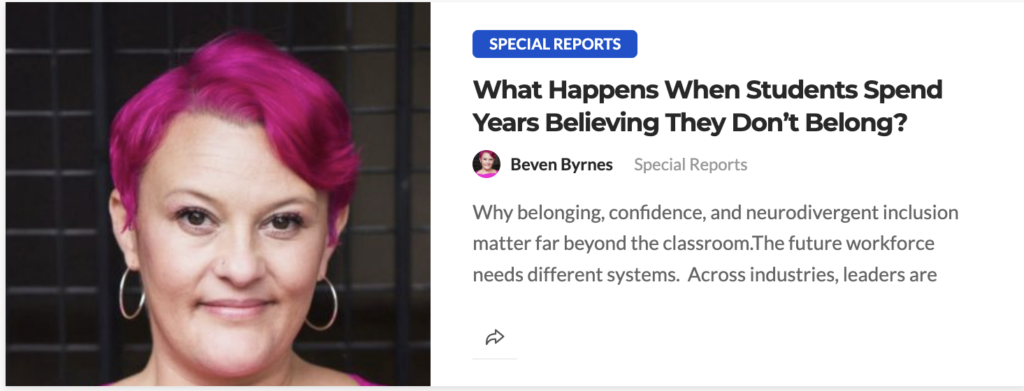
In the report, Beven argues that many of the challenges organizations face today — from employee engagement to leadership development — often begin much earlier than adulthood. Long before students enter the workforce, they are learning whether their voices matter, whether mistakes are safe, and whether they truly belong.
As Beven writes, “The workforce challenge does not begin at age twenty-two. It begins when a child starts believing, ‘This place was not built for me.’”
For many neurodivergent students, including those with autism, ADHD, dyslexia, sensory processing differences, and anxiety, traditional educational environments can unintentionally send messages that their differences are problems to overcome rather than strengths to embrace. Over time, these experiences can affect confidence, self-advocacy, and a student’s belief in their own potential.
The report emphasizes that belonging is not simply a feel-good concept. It is foundational to learning, growth, and future success. When students feel understood and supported, they are more likely to take risks, ask questions, develop resilience, and recognize their own strengths. Confidence grows through these experiences and becomes a critical skill that students carry with them into adulthood.
Beven also highlights the importance of helping students develop self-awareness and self-advocacy long before they enter the workforce. Students who understand how they learn, can communicate their needs, and feel empowered to seek support are better prepared to navigate school, work, and life.
The report further explores the connection between neurodiversity and leadership. Many neurodivergent individuals bring valuable strengths, including creativity, innovation, persistence, systems thinking, and the ability to see patterns and possibilities that others may miss. When schools create environments where those strengths can flourish, students gain the confidence to contribute their ideas and envision themselves as future leaders.
The report concludes with a challenge that resonates deeply with our mission:
“… stop asking, ‘How do we make this child fit the system? ‘ and start asking, ‘How do we build systems worthy of this child?’”
At our school, this belief guides everything we do. We know that when students feel seen, valued, and supported, they are better able to discover their strengths, develop confidence, and build the skills they need to thrive in school and beyond.
We are thankful Beven has the opportunity to contribute to the broader conversation about belonging, neurodiversity, leadership, and the future of education.
You can read the full special report here.