
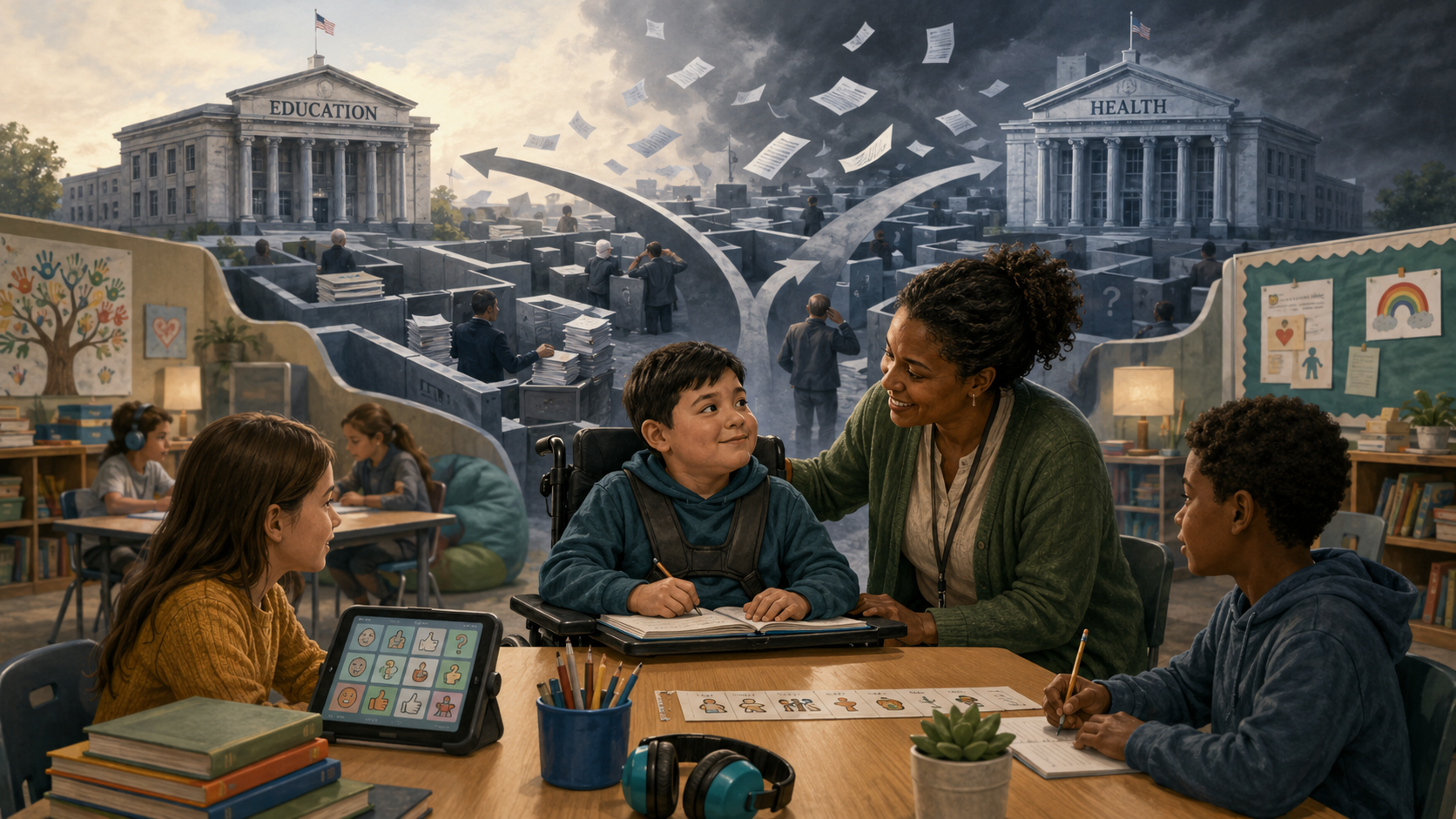
There are policy changes that sound technical until they land on a child’s desk.
Moving special education out of the Department of Education is one of them.
On paper, this may be described as an administrative shift: a transfer of programs, a set of interagency agreements, a reorganization of federal responsibilities. But for families, educators, and students with disabilities, this is not just bureaucracy. It is a signal. It says that special education can be separated from education itself.
That is the tragedy.
In June 2026, the U.S. Department of Education announced new partnerships with the Department of Health and Human Services and the Department of Justice. Under the plan, HHS would partner with the Department of Education on special education and rehabilitative services, while DOJ would take on a greater role in civil rights enforcement, student privacy protection, and related training and advisory work.
The Department describes this as a way to reduce red tape and improve coordination. Secretary Linda McMahon has argued that families need “less red tape” and “stronger results” in special education. But many disability advocates see something very different: the splintering of federal responsibility for students with disabilities. The Arc warned that moving special education and civil rights responsibilities out of the Department of Education risks creating a patchwork of rights for students with disabilities, while the American Occupational Therapy Association raised concerns about shifting IDEA-related responsibilities toward HHS.
Special education is not health care with a school bus attached.
It is education.
It is reading instruction, communication support, accessible classrooms, behavioral plans, related services, trained teachers, legal protections, and the daily work of ensuring that a child is not merely present in school, but meaningfully included in learning.
When special education is moved into a health-focused agency, students with disabilities risk being viewed first through a medical lens instead of an educational one. That distinction matters. A diagnosis may help explain a child’s needs, but it does not define their potential. The purpose of special education is not to manage disability. It is to guarantee access to learning.
For fifty years, the promise of IDEA has been rooted in a simple but powerful idea: every child is entitled to a free appropriate public education. That promise belongs in the agency charged with education. It belongs alongside the systems that oversee schools, support teachers, monitor state compliance, and understand the daily realities of classrooms.
Families already fight too hard for services. Too many parents know the exhaustion of repeated meetings, delayed evaluations, vague explanations, and the constant pressure to prove what their child needs. Moving oversight across agencies will not make that easier. It risks creating more confusion about who is responsible, where families should turn, and how accountability will be enforced.
And accountability is the heart of this issue.
When a child is denied speech services, when a student’s behavior plan is ignored, when a district fails to evaluate a child on time, when a wheelchair user cannot access a classroom, these are not abstract compliance problems. They are lost school days. Lost confidence. Lost trust. Lost opportunity.
A fragmented federal system makes it easier for responsibility to be passed around. Education can say it is a health issue. Health can say it is a school issue. Civil rights enforcement can become separate from educational support. Families can be left navigating a maze while their children wait.
Children with disabilities do not live in agency silos. They live whole lives. They need schools that see the whole child.
The Department of Education is not perfect. Special education has never been fully funded the way Congress originally promised. Enforcement has often been uneven. Families have long carried too much of the burden. But the answer to an imperfect system is not to scatter its responsibilities. The answer is to strengthen it.
If the goal is efficiency, then listen to families. Fund IDEA fully. Invest in special educators, paraprofessionals, therapists, and school psychologists. Reduce paperwork that does not help children. Improve dispute resolution. Make compliance faster and clearer. Support states and districts while holding them accountable.
But do not pretend that moving special education out of the Department of Education is a neutral act.
It changes the meaning of the work.
Special education says that students with disabilities are students first. They belong in classrooms, in curriculum, in school communities, and in the public promise of education. Removing special education from the federal education agency weakens that message at the very moment when families need it reinforced.
A child’s right to learn should not depend on which agency answers the phone.
Special education belongs in education because students with disabilities belong in education. Not adjacent to it. Not medically managed outside of it. Not administratively shuffled away from it.
In it.
Fully, visibly, and with the full force of federal protection behind them.