

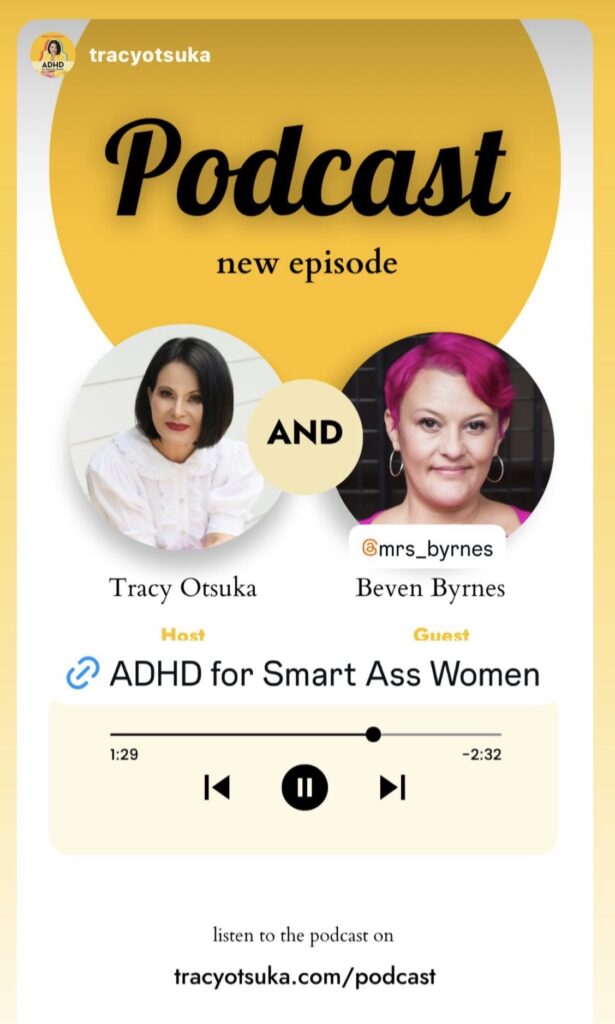
I recently had the honor of joining Tracy Otsuka on ADHD for Smart Ass Women for an episode titled “What Happens When a School Is Built for ADHD Brains.” Tracy’s podcast reaches a global audience and ranks in the top 0.1% worldwide, making this a meaningful opportunity to share the heart of Bridges Middle School with families, educators, and women who know what it feels like to navigate systems not built with their brains in mind.
At the center of our conversation was a simple truth:
ADHD is not a character flaw.
It is not laziness. It is not drama. It is not a lack of effort. For so many girls and women, ADHD has been hidden beneath achievement, perfectionism, emotional labor, anxiety, and exhaustion. They may appear to be functioning on the outside while quietly unraveling on the inside.
And functioning is not the same as thriving.
What if the environment is the problem?
In the episode, Tracy and I talked about what happens when we stop asking, “What is wrong with this child?” and start asking, “What is happening beneath the surface, and what does this child need?”
That question is at the center of our work at Bridges.
By the time many students come to us, they need more than academic support. They need repair. They need to rebuild trust in adults, trust in learning, and often trust in themselves. Many have spent years feeling like school is something they have to survive.
Our students are bright, creative, intuitive, funny, sensitive, and deeply capable. They are also often carrying years of being corrected, misunderstood, excluded, or labeled as “too much,” “lazy,” “defiant,” “dramatic,” or “unmotivated.”
But behavior is communication. Overwhelm is information. Shame is not a strategy.
At Bridges, we do not believe neurodivergent students need to be fixed. We believe they need to be understood.
ADHD in girls is often missed
One of the most important parts of this conversation was naming how differently ADHD can show up in girls and women.
When many people hear ADHD, they picture a child who is visibly hyperactive, impulsive, disruptive, or unable to sit still. But for many girls, ADHD can look like perfectionism, anxiety, emotional sensitivity, overachievement, chronic overwhelm, disorganization behind closed doors, or appearing successful while feeling like they are barely keeping up.
A girl with ADHD may not be the student disrupting the classroom. She may be the student quietly internalizing everything. She may be staying up too late trying to finish work that took her twice as long. She may be replaying every conversation. She may be masking so well that the adults around her never realize how much it is costing her.
The tragedy is that many girls are not identified because they are not making life difficult for the adults around them.
They are making life difficult for themselves.
School is never just school
For a child who learns differently, school shapes identity.
When a student spends years feeling behind, corrected, misunderstood, or excluded, that becomes part of how they see themselves. They begin to believe:
“I am not smart.”
“I am too much.”
“I am lazy.”
“I am bad at school.”
“I do not belong here.”
But when the environment changes, the child can change.
At Bridges, we see students begin to stand taller when the school day is designed around how they actually learn. Confidence grows when students experience competence. Mental health improves when children are no longer in survival mode every day.
Belonging is not a soft outcome. It is foundational.
A child cannot fully access learning if their nervous system is constantly defending them from shame, failure, rejection, or overwhelm.
We do not lower expectations. We change the conditions.
One misconception about neurodiversity-affirming education is that it means lowering expectations.
It does not.
At Bridges, we hold students to meaningful expectations. We also understand that students cannot meet expectations that are inaccessible, unclear, developmentally mismatched, or built for a brain that does not work like theirs.
We change the conditions so students can actually reach the expectations.
That means structure. Relationships. Explicit instruction. Flexibility. Accountability. Compassion.
It means understanding executive functioning, sensory needs, emotional regulation, learning differences, and the developmental realities of middle school.
It means seeing the whole child, not just the behavior, the grade, the diagnosis, or the moment of struggle.
A more compassionate world for ADHD brains
What I hope listeners take away from this episode is that children are not broken.
Women are not broken.
Neurodivergent students are not broken.
For too long, girls and women with ADHD have been applauded for endurance while quietly drowning in overwhelm. We need a more compassionate world for girls — one where they are seen before they collapse, supported before they burn out, and understood before they are mislabeled.
Strength is not pushing until collapse. Strength is self-understanding. Strength is asking for support. Strength is building systems that do not require constant self-abandonment.
At Bridges, this is the work we are called to do every day.
Not fixing children.
Seeing them.
Supporting them.
Building a school where they can finally breathe.
I am deeply grateful to Tracy Otsuka for creating space for this conversation and for helping so many women fall in love with their ADHD brains. I am equally grateful to the Bridges students, families, and educators who continue to show us what becomes possible when belonging, learning, and dignity are built into the foundation of school.
Listen to the episode, “What Happens When a School Is Built for ADHD Brains”:
- On Spotify: What Happens When a School Is Built for ADHD Brains
- On Apple Podcasts: What Happens When a School Is Built for ADHD Brains
- On YouTube: What Happens When a School Is Built for ADHD Brains