

Helping Neurodivergent Kids Find Rest, Predictability, and Resilience This Summer
By the middle of summer, many families find themselves holding two seemingly competing truths.
Our kids need rest. They may be recovering from a school year filled with academic demands, social navigation, sensory overload, masking, transitions, and the daily work of functioning in environments that were not always designed for them.
And our kids may also need structure. Long stretches of unplanned time, shifting schedules, travel, camps, visitors, late nights, and last-minute changes can be surprisingly stressful for children who rely on predictability to feel safe and regulated.
For neurodivergent kids, summer is not always the effortless break adults imagine. A change in routine—even a welcome one—can require significant adjustment. The answer is not to schedule every minute. It is also not to abandon structure entirely.
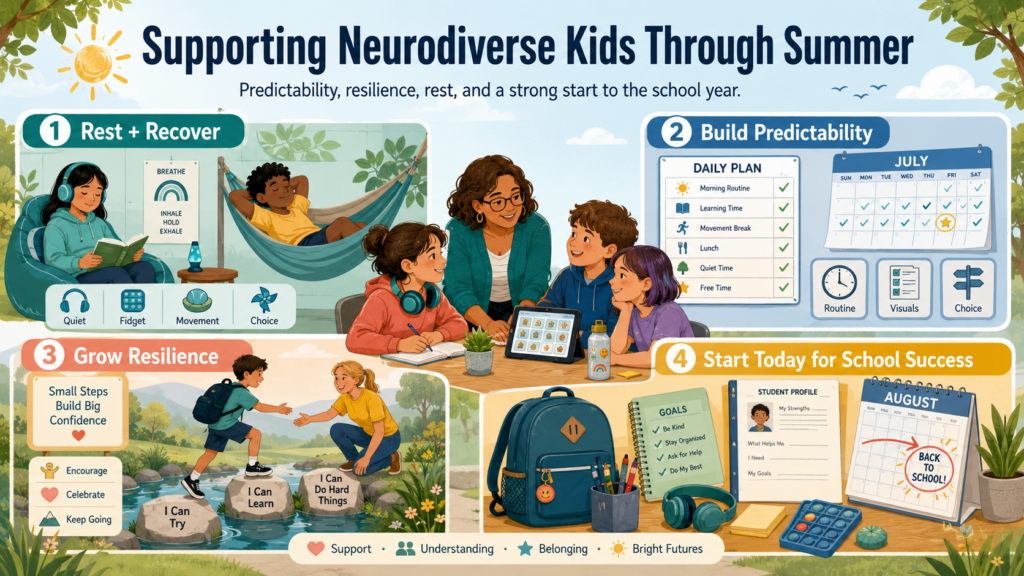
The goal is to create a summer rhythm that offers enough predictability to feel safe, enough flexibility to grow, and enough open space to recover.
And the good news is that families can begin today.
Start With Anchors, Not a Packed Schedule
Predictability does not mean rigidity. Your child does not need an hour-by-hour itinerary covering every day of summer.
Instead, identify a few reliable daily anchors:
- A general wake-up and bedtime window
- Predictable meals or snack times
- A brief morning preview of the day
- Time for movement or outdoor activity
- A protected period for quiet, independent recovery
- An evening check-in about the following day
A simple visual calendar can be especially helpful. Include camps, appointments, family visits, travel days, and unscheduled home days. When plans change, update the calendar together rather than simply announcing the change at the last minute.
For older children, invite them to help build the schedule. Middle schoolers need predictability, but they also need increasing autonomy. Offer meaningful choices: Would you rather go to the library Tuesday or Thursday? Do you want quiet time before or after lunch? Which family activity feels manageable this weekend?
The aim is not to control your child’s time. It is to make time easier to understand.
Treat Rest as a Need, Not a Reward
Many neurodivergent kids arrive at summer deeply tired.
They may have spent the school year managing sensory input, executive functioning demands, peer relationships, anxiety, academic frustration, or the pressure to appear more regulated than they actually felt. What looks like laziness, irritability, withdrawal, or excessive screen time may sometimes be a nervous system asking for recovery.
Rest should not have to be earned through productivity.
Build in days without appointments. Allow slower mornings. Protect time when your child does not need to talk, perform, socialize, transition, or solve a problem. Pay attention to what genuinely helps your child reset: reading, music, gaming, drawing, swinging, walking, building, watching a familiar show, spending time with an animal, or simply being alone.
Screens can also serve a meaningful purpose for some neurodivergent kids by providing predictability, regulation, connection, and access to special interests. The goal should be thoughtful balance rather than shame. Predictable start and stopping points, transition warnings, sleep protection, and a mix of online and offline opportunities are generally more useful than sudden or punitive restrictions. (Child Mind Institute)
Rest is not a break from development. Rest is part of development.
Build Resilience Without Forcing Distress
We sometimes talk about resilience as though children develop it by being pushed into uncomfortable situations and required to stay there.
But resilience is not the ability to silently endure overwhelming conditions. It is not masking, compliance, or remaining in distress to please an adult.
Resilience grows when a child experiences:
- A manageable challenge
- Meaningful preparation and choice
- Access to support
- A reasonable path out if the situation becomes too much
- Time to recover and reflect afterward
Summer offers many low-pressure opportunities to practice these skills.
A child might order their own meal, pack a bag for an outing, manage a small spending budget, attend part of a new activity, ask a librarian for help, try a different food, navigate a short social interaction, or take responsibility for one household task.
Choose challenges that stretch your child without flooding them. Prepare in advance. Explain what will happen, what might be difficult, what support is available, and how long the experience will last.
Afterward, resist the urge to evaluate immediately. Instead, ask:
- What felt easier than you expected?
- What was hard?
- What helped?
- What would you change next time?
- Do you need recovery time now?
Success does not have to mean completing the entire activity. Success may mean noticing discomfort, communicating a need, trying for five minutes, asking for help, or leaving before reaching a point of shutdown.
That is resilience, too.
Keep Learning Alive—Without Turning Summer Into School
Summer learning does not need to look like worksheets and required reading lists.
Follow your child’s interests. Read graphic novels, recipes, game instructions, sports statistics, fan fiction, maps, or articles about a favorite topic. Practice math while cooking, shopping, building, budgeting, or planning a trip. Visit the library, listen to podcasts, create art, take photographs, grow something, play strategy games, or explore a neighborhood on foot.
Ten minutes of enjoyable, interest-based learning can be more meaningful than an hour of conflict.
For students receiving specialized instruction or tutoring, consistency may still be important. But even structured summer learning should include choice, movement, breaks, encouragement, and a clear stopping point. Understood.org’s summer resources emphasize that a healthy summer for students with learning differences can include both rest and opportunities to remain active and engaged.
Our goal is not to ensure that children return to school already exhausted from preparing for school.
Begin the Back-to-School Transition Now
Starting today does not mean ending summer early.
It means using the remaining weeks to create a gentler transition rather than waiting until the final Sunday night to reset sleep schedules, discuss school worries, locate supplies, and introduce an entirely new routine.
Here are a few steps families can begin now.
1. Reflect on the Previous School Year
Ask your child what they want their new teachers to know.
What helped them learn? What made it harder? When did they feel successful? When did they feel misunderstood? What signs showed that they were becoming overwhelmed? Which adults helped them feel safe?
Keep the conversation brief and collaborative. Some children will talk more easily while walking, drawing, driving, or doing another activity. Others may prefer to write, type, or choose answers from a list.
Understood offers a helpful back-to-school worksheet that families can complete together to identify strengths, challenges, and lessons from the previous year.
2. Create a One-Page Student Profile
Prepare a brief, strength-based introduction for your child’s teachers or school team. Include:
- Interests, strengths, and sources of motivation
- Effective learning strategies
- Communication preferences
- Sensory or environmental needs
- Early signs of stress or overload
- Strategies that help with regulation
- Accommodations or supports that are especially important
- What your child would like adults to understand about them
Whenever possible, create this with your child rather than about your child.
Understood provides downloadable back-to-school introduction letters, including an option designed for middle school students.
3. Review Existing Support Plans
If your child has an IEP, 504 Plan, service plan, accommodation plan, behavior support plan, health plan, or another individualized school plan, review it before the year begins.
Ask yourself:
- Does this still reflect my child’s current needs?
- Which accommodations were consistently helpful?
- Which supports were written down but not reliably provided?
- Have there been new diagnoses, evaluations, medications, or recommendations?
- Are there social, sensory, emotional, or executive functioning needs that should be discussed?
- Who will be our primary school contact?
Families navigating special education in Oregon can use FACT Oregon’s education tools and toolkits, which include information about IEPs, school behavior, family-school communication, and advocacy. FACT Oregon is Oregon’s designated Parent Training and Information Center and also offers individualized support to families navigating IEPs and 504 Plans.
4. Gradually Reintroduce School-Year Rhythms
A few weeks before school begins, start adjusting sleep and wake times in small increments rather than making a dramatic change overnight.
Practice the morning sequence. Decide where backpacks, shoes, chargers, lunch supplies, and school materials will live. Use a written or visual checklist if that helps your child complete routines more independently.
For children who feel anxious about transitions, consider a low-pressure rehearsal:
- Drive or walk the school route
- Visit the campus if permitted
- Look at staff photos
- Review the daily schedule
- Practice opening a locker or using a planner
- Talk through lunch, arrival, dismissal, and transportation
- Identify where the child can go when they need help
Understood also offers a free four-week back-to-school plan with small, manageable actions families can take before the first day.
5. Plan for After-School Recovery
For many neurodivergent students, getting through the school day requires tremendous effort. They may arrive home talkative and energized—or silent, irritable, tearful, explosive, or completely depleted.
Plan now for what after-school recovery might look like.
Your child may need food before conversation, quiet before homework, movement before sitting, or significant decompression before being asked questions about the day. Avoid overscheduling the first several weeks of school when possible.
The transition home is part of the school day. A child who holds everything together at school may release accumulated stress only after reaching a safe environment. That does not necessarily mean the child had a successful or easy day. It may mean home is where they finally feel safe enough to stop holding it all in.
A Gentle “Start Today” Family Plan
Today, choose just one step:
- Put upcoming activities on a shared calendar.
- Establish one predictable daily anchor.
- Ask your child what helps them recover.
- Select one manageable responsibility to practice.
- Begin a one-page student profile.
- Locate and review school support documents.
- Identify one concern to share with the school team.
- Protect one completely unscheduled period this week.
You do not have to solve the entire summer—or the entire school year—today.
Small, thoughtful adjustments made now can reduce the intensity of the transition later.
Resources for Families
- Understood Summer Guide: Summer routines, camps, travel, social connection, learning, and extended school year information for families of children who learn and think differently.
- Understood Back-to-School Toolkit: Resources addressing school anxiety, routines, IEPs, 504 Plans, organization, teacher communication, and first-day transitions.
- FACT Oregon: Oregon-specific special education support, family advocacy tools, training, IEP guidance, and individualized assistance.
- Autism Society of Oregon: Statewide family resources, support groups, community connections, camps, and service directories.
- Child Mind Institute Back-to-School Resources: Guidance for families supporting children with anxiety, attention differences, learning disorders, and other mental health or developmental needs.
Readiness Begins With Feeling Understood
At Bridges Middle School, we know that school readiness is about far more than supplies, schedules, and academic skills.
A student is better prepared to learn when they know:
The adults around me understand how I learn.
My needs are not a problem.
I am allowed to ask for help.
There is a plan for when things become difficult.
I do not have to hide who I am to belong.
Let summer remain summer. Let there be sleep, joy, boredom, play, connection, and plenty of room to breathe.
But within that freedom, offer a few steady anchors. Practice small acts of independence. Begin conversations with the school team before concerns become crises. Make space for your child’s voice. And remember that preparing for a successful school year does not require pressure.
It begins with safety, connection, and the quiet confidence that comes from knowing what to expect.
Belong. Learn. Soar.