
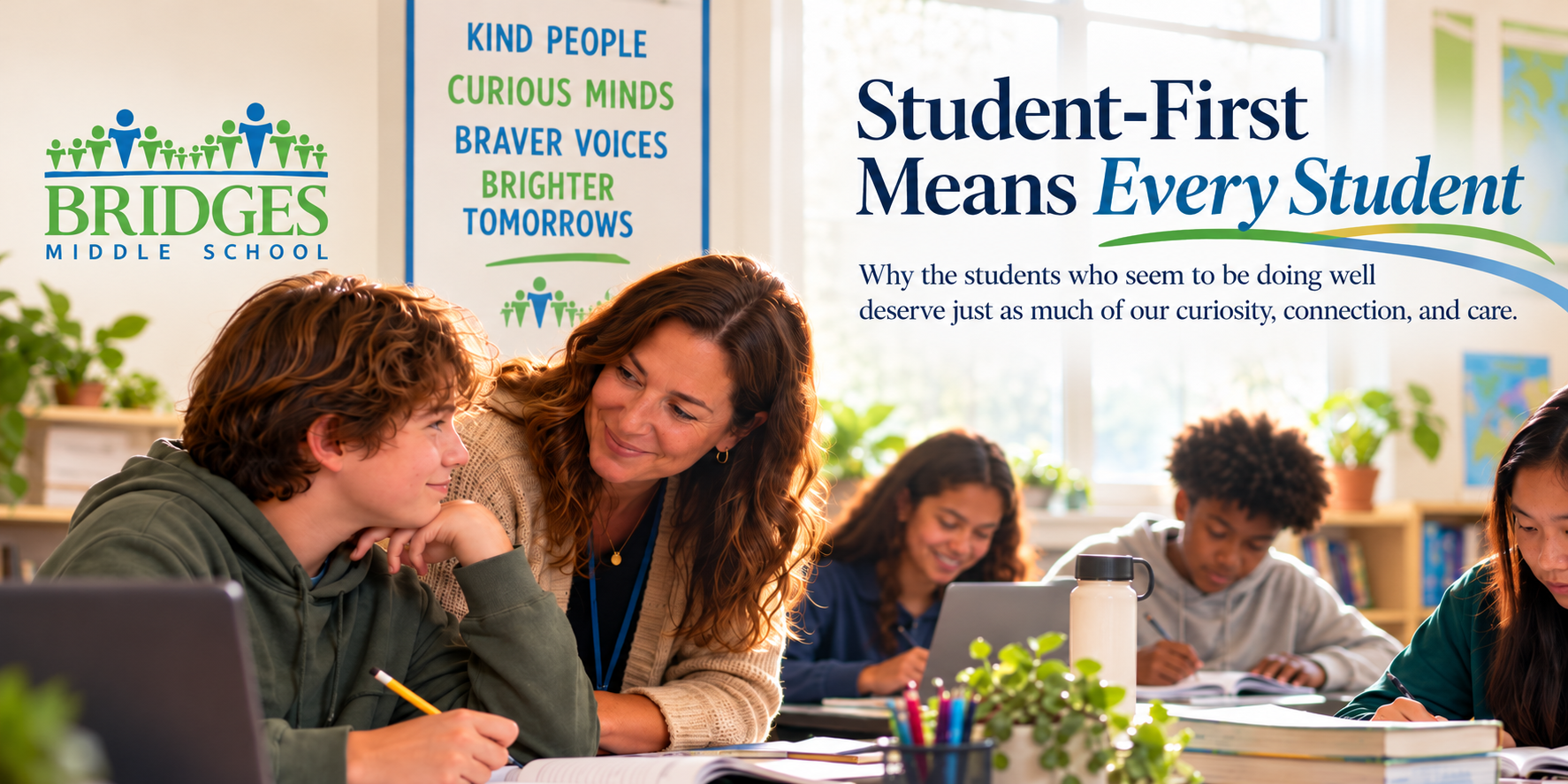
Why the students who seem to be doing well deserve just as much of our curiosity, connection, and care.
When I think about what makes Bridges different, I think about the experience we want every child to have when they walk through our doors:
Someone here knows me. Someone is glad I am here. Someone is paying attention to who I am becoming.
Not just when something goes wrong. Not just when they need help getting through a difficult moment. Not just when their needs become impossible to miss.
Every day, simply because they belong here.
Educator Trell Allen reminded me: “A student shouldn’t have to become a problem before they become a priority.”
For me, that connects directly to a responsibility at the heart of our work at Bridges: A student should never have to struggle more visibly to be seen more fully.
We talk about being a student-first school. But those words matter only when they shape how we spend our time, where we direct our attention, and whose experience we consider.
Student-first means every student—including the ones who seem to be doing just fine.
Small classrooms are an opportunity, not a guarantee
At Bridges, our small classes are intentional. They create room for the kind of teaching and relationship-building central to our mission.
But a small class does not automatically mean every child feels known.
The number of students in a room creates an opportunity. What we do with that opportunity is what matters.
We can notice that a student who usually has something to share has become quieter. We can see that someone who finishes every assignment is ready for a greater challenge. We can ask whether time spent alone is a welcome break or something a student wishes were different.
We can remember the thing they were excited about yesterday and ask about it today.
These may seem like small moments alongside planning lessons, teaching skills, and assessing progress. To a child, though, they can communicate something essential: My teacher notices more than my work. My teacher notices me.
That is part of what our small classrooms are for.
And I want to acknowledge something important: A small class is not necessarily an easy class. Supporting neurodivergent learners requires skill, flexibility, preparation, and thoughtful collaboration. You can’t measure the complexity of that work by counting chairs.
Our small classes do not remove that complexity. They give us the possibility of knowing each student more deeply—and the responsibility to keep making that possibility real.
“Doing well” should begin a conversation, not end one
There is nothing wrong with being quiet, independent, agreeable, or comfortable working alone. We don’t need to turn every quiet child into an outgoing one, and we shouldn’t assume every student who meets expectations is secretly struggling.
Sometimes a student truly is doing well.
Wonderful. Let’s celebrate that.
Then let’s remain curious.
What are they proud of? What are they learning that surprises them? What is challenging them in a good way? Where would they like to stretch? Do they feel connected to their classmates? Do they feel comfortable making a mistake or asking for something different?
A thriving student still deserves a teacher’s time and enthusiasm. They still deserve meaningful feedback, an appropriate academic challenge, and opportunities to discover strengths they have not yet recognized.
Children do not have to be struggling to deserve our attention.
At the same time, completed assignments and a quiet seat cannot tell us everything about a child’s experience. I do not want “They’re doing fine” to become a substitute for knowing what school actually feels like to them.
A student who rarely needs redirection is different from a student who feels confident, connected, and engaged. Sometimes those descriptions belong to the same child. Sometimes we need to ask more questions.
Our job is to stay interested enough to find out.
Urgency cannot be our only guide
Anyone who has worked in a classroom knows that we don’t always get to distribute attention according to a plan.
A student becomes overwhelmed. A conflict needs support. A safety concern requires an immediate response. Teachers make countless decisions while also trying to keep learning moving forward.
Those moments matter. Students experiencing visible distress deserve compassion, skilled support, and clear, consistent expectations.
But the students around them matter just as much.
We cannot let children who are managing well become the ones always expected to wait, adjust, be understanding, or need less.
Their learning matters now. Their sense of safety matters now. Their opportunity to connect with a trusted adult matters now.
This is not a call to care less for students whose needs are more visible. It is a call to ensure urgency does not become the only thing that determines who receives our care.
And this cannot rest entirely on an individual teacher’s shoulders.
As a school leader, I have a responsibility to create the conditions for teachers to serve the whole classroom: opportunities to collaborate, access to support, clear expectations, and a willingness to address patterns that repeatedly interfere with students’ learning.
“See every child” should never be shorthand for “Somehow do more, alone.”
It is a commitment we have to hold together.
A challenge to keep noticing
Here is a challenge I offer to educators—and one I take myself seriously.
Think through the students in your care. Consider what you know about each of them beyond their academic performance and behavior.
Whose interests can you describe? Whose recent accomplishment have you celebrated? Who has shared an opinion with you lately? Whose next learning goal can you name?
Whose experience do you mostly assume is positive because they haven’t told you otherwise?
Notice where your answers become less clear. Not as an exercise in guilt, but as an invitation.
Then begin with two or three of those students.
Ask what they wish there were more time for in class. Find out what excites them outside school. Ask whether the work feels too easy, too hard, or appropriately challenging. Notice something specific about their thinking, creativity, effort, or kindness.
Make room for different ways of responding. A meaningful check-in does not have to be a face-to-face conversation. It might happen through writing, drawing, a shared activity, or a question followed by enough time to think.
The goal is not to uncover a problem or require a personal disclosure. It is to communicate genuine interest.
Then follow up.
Remember the interest. Return to the question. Offer the challenge. Ask how something turned out.
That is how a brief interaction becomes a relationship. It is how “My teacher asked me something” becomes “My teacher knows something about me.”
For parents and caregivers, there is an invitation here, too: Help us know what we might not yet see. Share what your child is excited about, what they are hoping for, and what they wish were different. Our understanding of a student should always have room to grow.
Why our teachers matter so much
A school’s mission becomes real not because it appears on a website or hangs on a wall.
It becomes real in students’ daily experience.
At Bridges, our teachers bring that mission to life through the thoughtful challenge they offer students ready for more. Through the question they ask someone who rarely volunteers. Through the effort they recognize that might otherwise go unnoticed. Through the relationship they keep building, even when a child doesn’t appear to need anything from them.
I am deeply grateful for that work.
It is demanding, human work, and much of it happens without an audience. Yet those everyday interactions are where our values become something a child can actually feel.
I want our students to know they don’t have to earn connection by being easy, impress us by being exceptional, or reach a point of distress before we make room for them.
They already belong. They already matter.
That is what I want us to keep building at Bridges: a school where small classrooms support big possibilities, where success invites continued investment, and where every child receives more than the absence of concern.
They receive our curiosity. Our encouragement. Our attention. Our belief in what comes next.
Belong. Learn. Soar.
That promise is for every student in the room.